
Sinclair Orbs
Investigation Report
A formal review of 19 video recordings submitted by the Sinclair household. CAPRI Labs analysts examined the footage for visual anomalies and environmental particulate, documenting the observations and filtered-image frames presented below.
A key challenge in this investigation is that genuine anomalies and dust particulate appear in the same footage — sometimes in the same frame. The intelligently moving anomalies move differently than regular dust particles. The following criteria were used to distinguish confirmed anomalies from environmental false positives:
- Velocity inconsistent with passive airborne drift
- Directional change or acceleration not explained by air current
- Luminosity or appearance inconsistent with dust reflection
- Purposeful movement near or around specific persons or areas of interest
- Curved trajectory demonstrating apparent awareness of subject position
The following three recordings were selected from the full 13-clip submission as the most significant examples of anomalous activity. These are the clips where orb behavior most clearly distinguishes itself from environmental particulate.
This recording contains the most clearly defined anomaly in the submission. The orb exhibits a curved trajectory that moves toward and then away from the woman in frame — a behavior pattern inconsistent with passive airborne drift or any known environmental artifact. The movement suggests spatial awareness of the subject: the orb appears to approach, adjust course in proximity to her, and then retreat. Critically, when a male subject is also present in the footage, the orb demonstrates no comparable interest or proximity behavior toward him. This selective attention — concentrating around the woman and ignoring the male — is one of the most significant behavioral data points in the entire submission and strongly supports an intelligent, intentional presence rather than a random environmental phenomenon.
This is the standout clip of the submission. The subject-selective behavior — concentrating around the woman while ignoring the male — is the single most compelling data point in the entire case. Random environmental phenomena do not discriminate between subjects.
This recording contains a mix of environmental particulate and anomalous activity. Dust anomalies are present — particles exhibiting passive drift consistent with ambient airflow — but alongside them, intelligently moving orbs can be observed. The key distinction is behavioral: the anomalous elements move differently than the dust, exhibiting directional changes and velocity patterns inconsistent with passive airborne drift. The presence of dust in the same frame makes this clip more analytically complex, but the anomalous elements are distinguishable upon careful review.
The coexistence of dust and genuine anomalies in the same recording is common in residential IR footage. It does not invalidate the anomalous findings — it requires more careful analysis to separate the two.
This recording contains anomalous activity consistent with orb phenomena. Movement patterns observed in this clip exhibit the behavioral markers outlined in Section 2 — velocity and trajectory inconsistent with passive environmental drift. This clip was selected for inclusion in the featured section as a supporting example of the broader pattern of anomalous activity documented across the Sinclair submission.
Across the submission, orb activity concentrates around the female subject and shows no comparable interest in the male subject present in the same footage. This selectivity is one of the strongest indicators of intelligent, intentional behavior — random environmental phenomena do not discriminate between people in the same space.
The confirmed anomaly in GMo1ud demonstrates clear proximity behavior — curving toward and away from the woman in frame. The orb adjusts its trajectory in direct response to her position, then withdraws. This is consistent with documented orb interaction patterns in residential investigations.
Multiple recordings contain both genuine dust particulate and anomalous orb activity in the same frame. This is common in residential IR footage and requires careful behavioral analysis to separate the two — which is precisely what CAPRI Labs is trained to do.
Anomalous activity was captured across multiple cameras and time windows in the submission. This is not an isolated event — it indicates an ongoing presence at the property that warrants extended multi-night monitoring and direct communication attempts.
The following six recordings were submitted in a second batch. All were reviewed in full. Analyst findings are provided for each clip.
Multiple orbs visible throughout the 20-second clip, drifting continuously across the room. A notable orb passes near the man's head and shoulder area at approximately 0:16 while he stands at the sliding glass door. The majority of particle movement is consistent with ambient airflow; however, several orbs exhibit velocity and trajectory worth noting in the broader context of the submission.
Subject present: male. Orb activity near subject at 0:16.
An older adult using a walker moves through the hallway and into the dining area. Two fast-moving particles are observed at 0:06–0:07 and 0:12–0:13 in the upper portion of the frame. Their movement is rapid and directional. Subject-selective context: the orbs present as the older adult (female) moves through the space.
Subject present: older female adult. Fast-moving particles at 0:06 and 0:12.
A bald male subject enters from the hallway. At 0:03–0:04, a bright circular object appears on the far left edge of the frame and moves in a downward-rightward trajectory, disappearing near the bottom left corner. The object appears as the man approaches the end of the hallway. After he exits the frame at 0:10, no further activity is observed for the remainder of the clip.
Orb appears at 0:03 as male subject approaches. No further activity after he exits.
Two distinct light flashes are recorded in this clip. The first occurs at 0:04 on the left side of the frame as the male subject opens the door to go outside. The second occurs at 0:11 near the top right of the doorframe shortly after he returns inside and closes the door. Both flashes are brief and localized. Their timing — correlated with the door opening and closing — may indicate a reflective or environmental cause, but the second flash in particular occurs after the door is already closed and warrants notation.
Two light flashes at 0:04 and 0:11. Timing correlates with door movement. Second flash post-door-close is notable.
Continuous orb/particulate activity throughout. A prominent large orb drifts diagonally from the top left at 0:02. At 0:20, a fast-moving bright streak crosses the top right of the frame from right to left — consistent with a small insect or fast-moving particle near the IR source. Particle density increases noticeably when the male subject walks through the room, likely due to air displacement.
Fast streak at 0:20. Particle density increases with subject movement.
A bright circular orb appears in the upper center-left of the frame at 0:00–0:02, moving diagonally downward before disappearing. At 0:02, an older woman enters the frame from the bottom left and moves toward the dining table and wheelchair. She interacts with items in the area from 0:05–0:15, then exits. The orb appears immediately before her entry — a timing correlation consistent with the subject-selective pattern documented throughout this submission. The female subject's presence in this clip adds to the cumulative behavioral data.
Orb appears at 0:00 immediately before older female subject enters frame at 0:02. Timing correlation is notable.
Selected frames from the submission were processed through CAPRI Labs' anomaly enhancement filters — color spectrum isolation and contrast amplification applied to reveal structural detail not visible in standard IR playback. Three frames were flagged for inclusion.
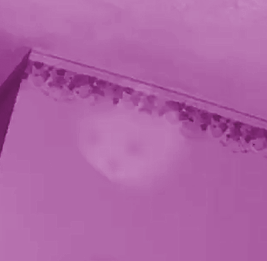
Under color spectrum filter, the orb reveals a distinct internal structure with two dark circular formations and a lower curved feature — consistent with facial geometry. The symmetry of these features is not consistent with random light diffraction or lens artifact. The formation appears in the upper portion of the frame near the ceiling, positioned in the area where the orb was observed approaching the female subject. This is the most visually significant frame in the submission.
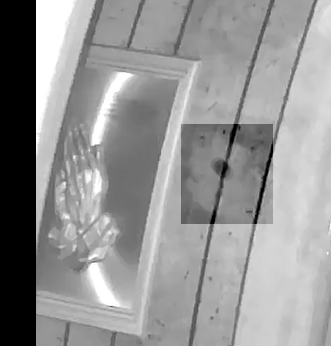
A dark, roughly circular anomaly is visible in the lower-right quadrant of the frame, adjacent to a framed praying hands image on the wall. The anomaly is distinct from the wall surface and appears to have defined edges inconsistent with shadow or reflection. Its proximity to the religious artwork is noted — whether coincidental or behaviorally significant is a question that warrants on-premises investigation. The contrast between the bright wall art and the dark orb formation is unusual.
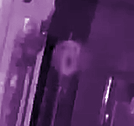
Under purple spectrum filter, this orb displays a clearly defined concentric ring structure — a bright inner core surrounded by a darker band and an outer luminous edge. This three-layer formation is a hallmark of genuine orb phenomena as documented in residential IR investigations. Dust particles and lens backscatter do not produce this type of structured internal geometry. The orb appears in the lower-left portion of the frame, positioned in the hallway area consistent with the movement corridors observed across multiple recordings in this submission. This frame, combined with Frame A, provides the strongest photographic evidence in the case.
Of the 13 video files submitted, anomalous activity was identified across multiple recordings. The three clips featured in Section 3 represent the clearest examples — particularly GMo1ud, which contains a confirmed orb exhibiting subject-relative curved trajectory behavior. The remaining recordings in the submission contain a mix of environmental particulate and, in several cases, additional anomalous activity that warrants further review.
A particularly significant behavioral pattern emerged across the submission: orb activity concentrates around the female subject and shows no comparable interest in the male subject present in the same footage. This subject-selective behavior is one of the strongest indicators of intelligent, intentional presence in the entire case — environmental phenomena do not discriminate between people.
The challenge inherent to this case is that genuine anomalies and dust particulate appear in the same footage. The intelligently moving anomalies move differently than regular dust particles — they exhibit purposeful trajectory, subject-relative behavior, and velocity patterns inconsistent with passive drift. This distinction is what CAPRI Labs brings to an investigation.
This conclusion was independently corroborated by a second analyst reviewing the footage without prior briefing. Their assessment aligned with the primary review: the orbs want to be around the woman and not the male — they do not present when he is around. Independent confirmation of a behavioral pattern this specific significantly strengthens the evidentiary weight of this case.
Extended multi-night pattern review to determine whether anomalous events are recurring or isolated
Audio analysis of all footage for corroborating EVP-type evidence
Cross-referencing timestamps across all 19 recordings for clustering patterns
Preserving source clips and recording conditions for any future comparison
Continue Documenting the
Observed Pattern
The most useful next step is continued, consistent documentation. The review notes an apparent concentration of reported orb activity around the woman in the household, but footage alone cannot establish a cause or intention. Future clips should preserve the full lead-in and follow-through around each event, with the room conditions and every person present documented in the same record.
A future review can compare those conditions across the full set of recordings, separate likely environmental artefacts from unresolved visual events, and update this report as additional source footage becomes available. Keeping original files unedited and noting dates, times, camera placement, lighting, HVAC activity, doors, pets, and movement near the camera will make that comparison more reliable.
The footage you have captured is a useful starting record. Preserve the context around each event so the evidence can be assessed consistently over time.